
Emotional Support in the Moment: Helping Children Through Overwhelm
When a child is overwhelmed… It can feel urgent. Big emotions. Big reactions. And a strong pull to fix it quickly. But in those moments, what children need most isn’t correction. They need support. Not later. Not after they calm down. Right in the moment.
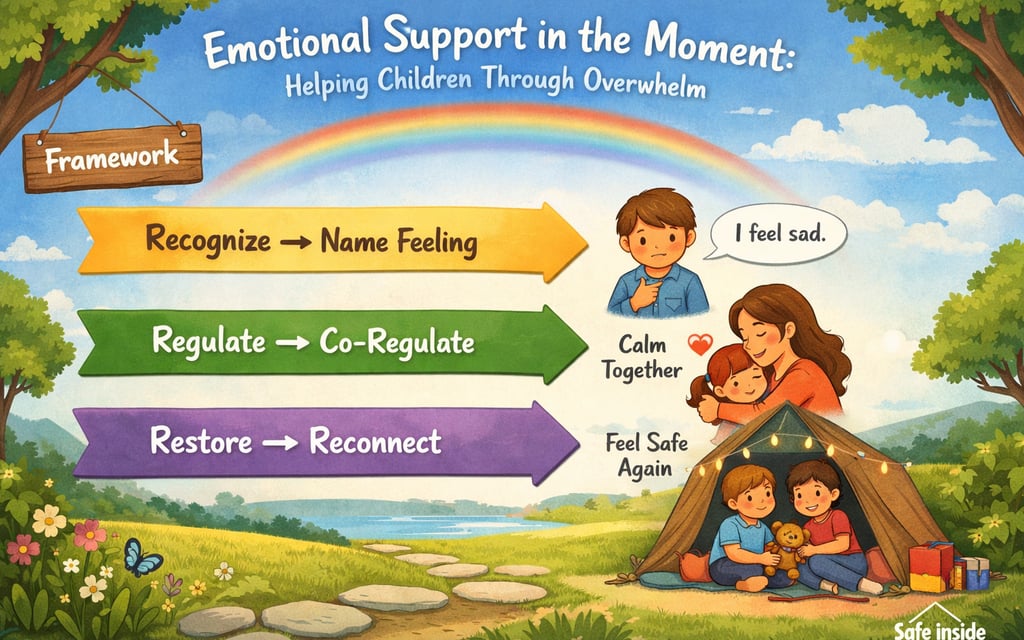
A Simple Way to Respond
When everything feels intense, it helps to have something simple to come back to.
A way to respond that doesn’t rely on guessing, reacting, or second-guessing yourself.
This is where a simple framework can help:
Recognize → Regulate → Restore
Not as a script.
But as a guide.
Step 1: Recognize → Name What’s Happening
Before anything can shift…
The experience needs to be seen.
This doesn’t mean analyzing or explaining.
It means gently naming what you notice.
You might say:
“That feels like a lot right now”
“I can see you’re really overwhelmed”
“Something doesn’t feel good in your body”
This does two things:
helps the child feel understood
begins to organize the experience internally
You’re not fixing it.
You’re helping make sense of it.
Step 2: Regulate → Co-Regulate First
Once a child is overwhelmed, they can’t regulate alone.
co-regulation comes first
This is where your nervous system becomes the support.
It might look like:
sitting close
soft voice
slowing your breathing
reducing stimulation
staying present without pressure
Sometimes, when appropriate, this may include a calming hug.
Not to stop the behaviour.
But to offer safety.
You don’t need to say much.
Often, just being there: steady, calm, and grounded is enough.
And over time, something subtle happens:
their nervous system begins to settle with yours
Step 3: Restore → Reconnect and Integrate
Once the intensity passes…
That’s when restoration begins.
This isn’t about going back to “normal” right away.
It’s about reconnecting.
You might:
sit together quietly
offer comfort
check in gently
bring warmth back into the moment
Later, if needed, you can:
reflect
problem-solve
talk about what happened
But only once regulation has returned.
Why This Works
This approach follows the nervous system.
Instead of trying to think your way out of overwhelm
It supports the body first.
Because when a child is overwhelmed:
logic isn’t available
reasoning isn’t accessible
control isn’t possible
But safety is.
And safety is what allows everything else to come back online.
What This Looks Life in Real Life
It’s not perfect.
It’s not scripted.
It might look like:
taking a breath before responding
saying less instead of more
sitting beside instead of stepping in
choosing connection over correction
Small shifts.
Big impact.
The Safe Inside™ Perspective
From a Safe Inside™ lens:
Overwhelm is not something to stop,
it’s something to support.
When children feel safe in those moments…
They begin to trust:
their emotions
their body
and the people supporting them
And over time:
support becomes capacity.
Bringing it Together
You don’t need to have all the answers.
You don’t need to do it perfectly.
You just need a place to begin.
Recognize
Regulate
Restore
Again and again.
Until it becomes natural.
© 2026 Coaching with Rhonda. All rights reserved.
Rhonda Tournay is a trauma-informed coach and educator specializing in nervous system regulation, neurodivergence, and emotional health — helping individuals, families, and professionals find safety and resilience through the Safe Inside™ Protocol.

