
Helping Children Regulate: Supporting Big Emotions Through the Nervous System
When children are overwhelmed, it can show up quickly. Big emotions. Big reactions. Big behaviours. It might look like defiance, meltdowns, withdrawal, or complete shutdown. But underneath all of it, something important is happening: your child’s nervous system is struggling to regulate. And when we begin to understand behaviour through this lens, everything starts to shift.
A Different Way to Understand Behaviour
It’s easy to interpret behaviour as:
disrespect
defiance
attention-seeking
“not listening”
But from a nervous system perspective:
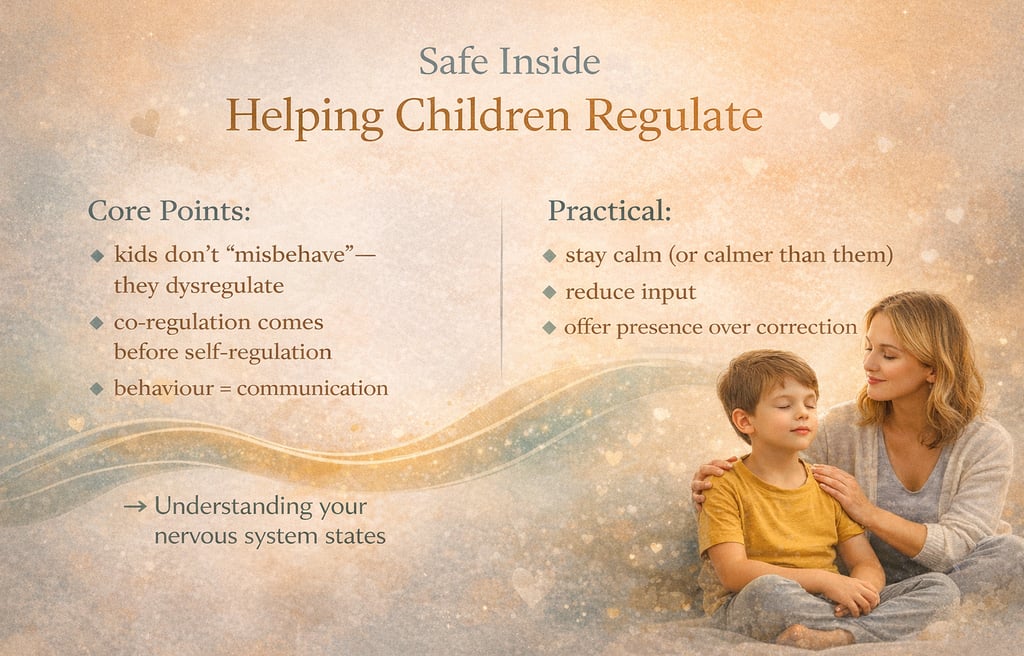
children don’t misbehave, they become dysregulated.
Their system becomes overwhelmed, and they don’t yet have the capacity to bring themselves back to a calm, regulated state on their own.
Co-Regulation Comes First
Before children can regulate themselves…
They need to experience regulation with someone else.
This is called co-regulation.
It looks like:
a calm presence
a steady voice
a supportive adult nearby
someone helping them feel safe enough
when appropriate, a calming hug
Sometimes, co-regulation doesn’t require words at all.
You might gently hold your child and focus on your own breathing so that it's slow, steady, and grounded.
Without saying anything, just breathing.
And over time, you may notice something subtle but powerful:
their breathing begins to slow with yours
This is the nervous system responding to safety.
Over time, these repeated experiences become internalized.
And eventually:
co-regulation becomes self-regulation.
Children’s nervous systems are highly responsive to the state of the adult they are with.
Your regulation becomes the pathway for theirs.
Behaviour Is Communication
.
When a child is overwhelmed, their behaviour is not random.
It’s communication.
They may be expressing:
“this is too much”
“I don’t feel safe”
“I don’t know what to do with this feeling”
“my system is overloaded”
When we shift from: “How do I stop this behaviour?”
to: “What is this behaviour telling me?”
We respond differently.
And more effectively.
Understanding What’s Happening in the Body
Children move through different nervous system states just like adults.
At times they may feel:
activated (anxious, reactive, intense)
overwhelmed (meltdown, explosive)
shut down (withdrawn, quiet, disconnected)
What Actually Helps in the Moment
When a child is dysregulated, logic won’t land.
Correction won’t land.
Teaching won’t land.
The nervous system needs support first.
1. Stay Calm (or Calmer Than Them)
You don’t need to be perfectly calm.
But your nervous system becomes an anchor for theirs.
Even a small shift matters.
2. Reduce Input
Overwhelm often increases with:
• noise
• demands
• conversation
• stimulation
Try:
• lowering your voice
• simplifying the environment
• pausing expectations
Less input = less overwhelm
3. Offer Presence Over Correction
This is one of the biggest shifts.
Instead of immediately correcting behaviour: offer connection first
This might look like:
• sitting nearby
• gentle reassurance
• saying very little
• being with them without pressure
Safety comes before strategy.
4. Support the Body
Regulation is physical.
You can support it through:
• deep breaths together
• movement
• holding a comforting object
• quiet space
These help the nervous system settle.
After the Moment
Once your child is calmer…
That’s when:
reflection
teaching
problem-solving
can begin.
Not before.
The Safe Inside™ Perspective
From a Safe Inside™ lens, children are not problems to fix.
They are nervous systems to understand.
What looks like difficult behaviour is often a system doing its best to cope with more than it can currently manage.
When we respond with regulation instead of reaction…
We don’t just stop the moment.
We build capacity for the future.
If you’d like simple, practical tools to support your child (and yourself) in moments like these:
© 2026 Coaching with Rhonda. All rights reserved.
Rhonda Tournay is a trauma-informed coach and educator specializing in nervous system regulation, neurodivergence, and emotional health — helping individuals, families, and professionals find safety and resilience through the Safe Inside™ Protocol.

