
Why Behaviour Isn’t the Problem (And What Actually Is)
Why Behaviour Isn’t the Problem (And What Actually Is): Understanding behaviour in the classroom starts with the nervous system. Learn why safety, regulation, and connection change how students learn and respond.
In education, behaviour is often treated as the problem.
We’re trained to manage it.
Correct it.
Control it.
From reward systems to consequences, the focus is typically on changing what we can see.
But what if behaviour isn’t the problem?
What if it’s the signal?
This shift, from behaviour as a problem to behaviour as communication is at the core of trauma-informed and nervous-system-informed education, and is explored in depth in the Safe Inside™ Educator Series.
In the classroom, behaviour tends to fall into familiar categories:
defiance
avoidance
disruption
These behaviours can feel frustrating and, at times, even personal. They interrupt learning, challenge authority, and can create tension in the classroom.
But underneath, there is often something very different happening:
overwhelm
anxiety
shutdown
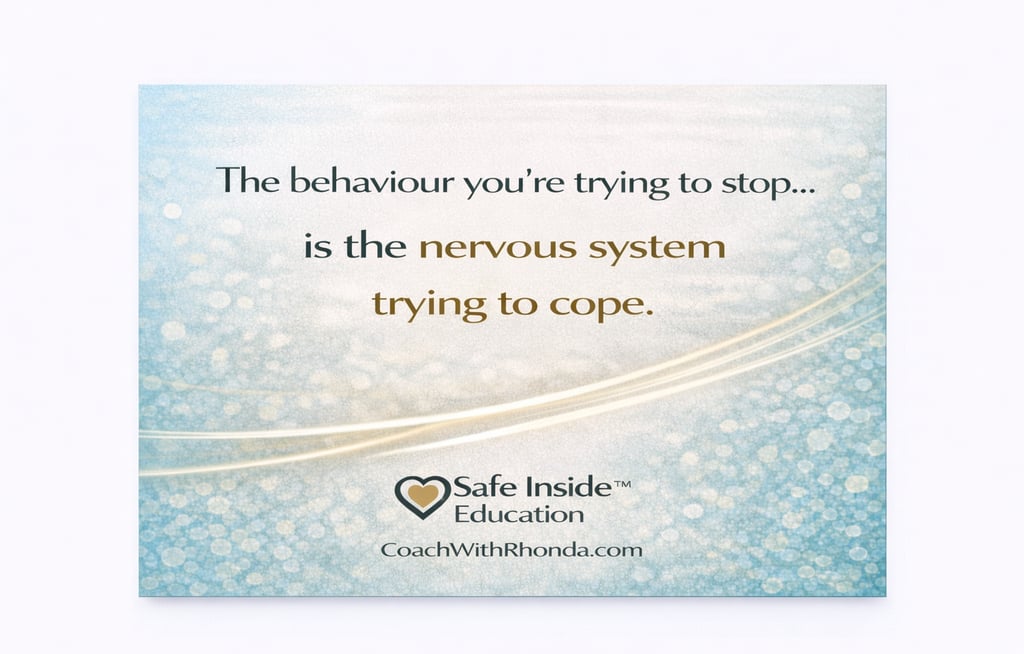
What looks like behaviour is often a nervous system under stress.
This distinction is foundational to understanding both neurodivergence and emotional regulation, as outlined in A Nervous System Map for the Neurodivergent Mind & Body.
What We See vs What’s Actually Happening
The Nervous System Perspective
When a student is dysregulated, their brain is not operating from a place of learning or logical decision-making.
It is operating from a place of survival.
The nervous system is constantly scanning for safety. And when it perceives a lack of safety, whether real or perceived it shifts into protection mode.
In that state, the brain is not asking:
“How do I behave?”
It is asking:
“Am I safe?”
If the answer is no, the brain prioritizes survival over learning.
This is why a student who is overwhelmed may appear defiant.
Why a student who is anxious may avoid work.
Why a student who is shut down may seem disengaged.
These are not conscious choices in the way we often assume.
They are nervous system responses.
Behaviour Is Coping
When we begin to understand behaviour through this lens, something important shifts.
What we often label as “bad behaviour” becomes easier to recognize as:
protection
adaptation
coping
Students are not trying to be difficult.
They are trying to manage internal experiences they don’t yet have the capacity or skills to regulate.
This distinction matters.
Because “won’t” assumes choice.
But “can’t” reveals capacity.
And those require completely different responses.
This is where the distinction between “can’t vs won’t” becomes essential, a concept explored further in The Framework, which outlines how behaviour, nervous system state, and capacity are interconnected.
Why Traditional Responses Fall Short
When behaviour is viewed as the problem, the response is often to increase control.
More rules.
More consequences.
More pressure.
But when the underlying issue is a dysregulated nervous system, these approaches can escalate rather than resolve.
This pattern is also reflected in compulsive and protective behaviours explored in Compulsive Coping, where behaviour is understood as an adaptive response rather than a failure. (👉 link to Compulsive Coping)
What Actually Helps
If behaviour is rooted in safety, then the response must be too.
Support starts with:
safety
regulation
connection
Safety allows the nervous system to settle.
Regulation allows the brain to come back online.
Connection creates the conditions for learning to happen.
When students feel safe, they can:
access learning
use their skills
engage more fully
This is not about lowering expectations.
It is about creating the conditions where students are actually able to meet them.
The Shift That Changes Everything
When we shift from:
“What’s wrong with this student?”
to:
“What does this student need?”
Everything changes.
This shift is the foundation of the Safe Inside™ approach, which integrates nervous system awareness, trauma-informed practice, and practical classroom application.
The Way We’ve Been Taught
Build Safety, Not Control
You don’t need to fix behaviour.
You need to build safety.
Because when safety leads, everything else becomes possible:
Learning improves.
Connection strengthens.
Regulation develops
This is the foundation of a nervous-system-first approach and the core of the Safe Inside™ Educator Series.
If you’re looking to apply this in real classroom settings, the Safe Inside™ Educator Series provides practical tools, frameworks, and real-world applications for educators.
© 2026 Coaching with Rhonda. All rights reserved.
Rhonda Tournay is a trauma-informed coach and educator specializing in nervous system regulation, neurodivergence, and emotional health — helping individuals, families, and professionals find safety and resilience through the Safe Inside™ Protocol.

